ELISA Enzymes for Kit Manufacturers and Distributors: HRP and AP Supply
Source HRP and alkaline phosphatase enzymes for ELISA with QC, COA/TDS/SDS, pilot validation, and cost-in-use guidance.

An ELISA kit business depends on two reporter enzymes, horseradish peroxidase (HRP) and alkaline phosphatase (AP), and on getting them in the same quality, order after order. For kit manufacturers the risk is a lot that shifts signal or background at release; for distributors it is a product their customers return.
This page compares the two enzymes from a buyer's point of view and sets out how to source, qualify and scale up supply. To request a quote, use the inquiry form on our home page or email hello@mail.enzymelinked.com with the product, quantity and destination country.
What kit makers and distributors need from an ELISA enzyme supplier
Kit manufacturers need enzyme lots that perform consistently in conjugates and in kit stability studies, pack sizes that fit their conjugation batches, and written notice before anything about the product changes. Distributors need the same consistency, plus documents they can pass on to their own customers.
We supply assay-grade HRP (200–400 U/mg) and alkaline phosphatase (1,000+ DEA U/mg) as lyophilized powder or solution, in pack sizes from 1 g to 1 kg with custom packaging.
HRP and alkaline phosphatase: a buyer's comparison
HRP is widely used where fast signal development with common chromogenic and chemiluminescent substrates suits the kit. It needs care with peroxide, azide and storage conditions.
Alkaline phosphatase is chosen where its substrates, longer signal development or a particular chemiluminescent platform suit the kit better. It works under alkaline substrate conditions and some buffer components can inhibit it.
For the buyer, the practical point is that the two are not interchangeable: a kit built on one needs re-optimization to move to the other. Many kit ranges carry both, so it often makes sense to qualify both enzymes from one source.
What to request before sampling
Ask for a COA, TDS and SDS for each candidate lot. The COA should state the activity method and units; the TDS should give storage, reconstitution for lyophilized material and handling limits.
Compare activity figures only on the same unit basis, because different methods give different numbers. If you will buy ready-made conjugates rather than the enzyme, ask separately for conjugate specifications.
Pilot validation and scale-up
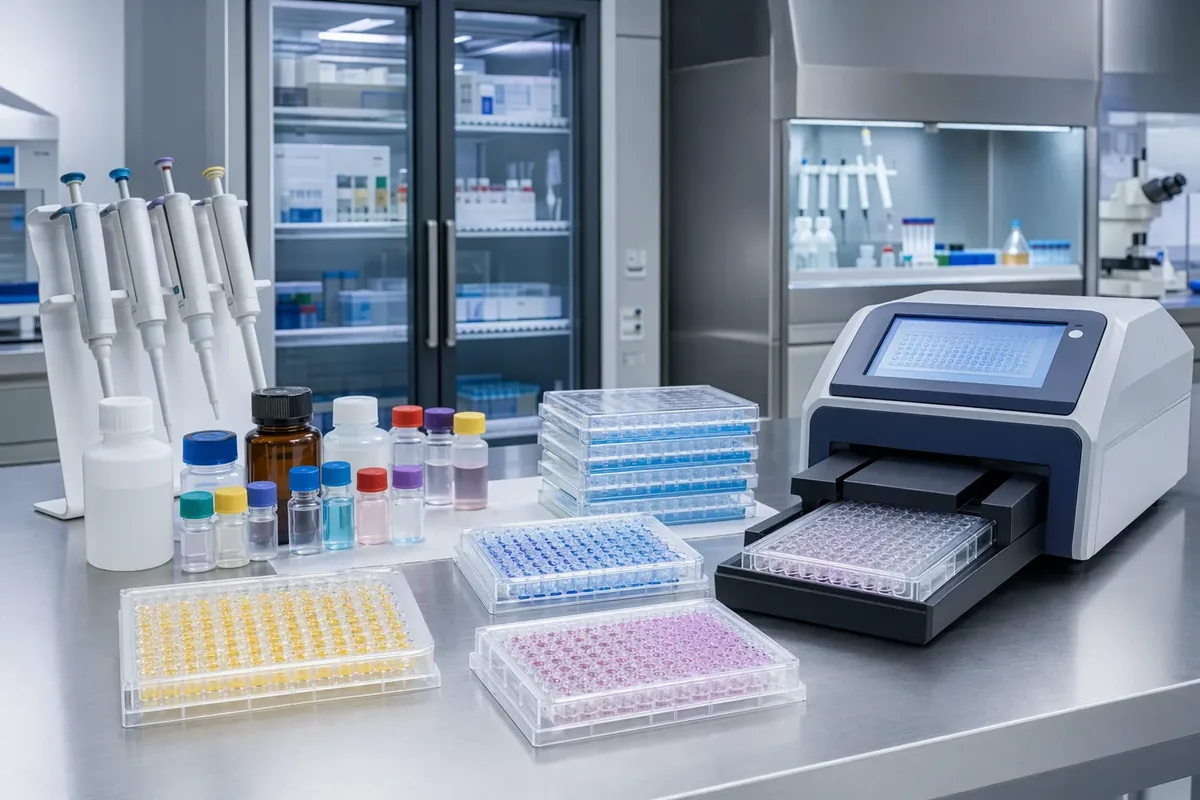
Test samples in your own kit format, changing one variable at a time: enzyme or conjugate dilution series, standard curve recovery, precision within and between runs, blank response and matrix interference.
Before scale-up, confirm that production lots come from the same route as the sample and plan pack sizes so that opened material is used quickly.
Cost-in-use and supplier qualification
The lowest unit price is not always the lowest manufacturing cost. Include enzyme dosage, conjugation yield, dilution factor, stability losses, QC failure rate and inventory risk.
Qualify the supplier on lot consistency, documents, packaging, lead time and responsiveness to quality questionnaires. Manufactured under ISO 9001 and ISO 13485 quality standards; supplied as RUO grade for assay development and research. Prices, lead times and freight are quoted per order; minimum order is 1 g for research quantities and 100 g for bulk.
What to send with a quote request
Product: HRP, alkaline phosphatase or both, with the grade and form.
Quantity: per order and per year, and the pack size.
Use: kit production, conjugate manufacture or resale.
Destination: the delivery country, so freight can be quoted.
To request a quote, use the inquiry form on our home page or email hello@mail.enzymelinked.com with the product, quantity and destination country.
Diagnostic Enzymes (ELISA & Assay Grade) for Research & Industry
Need Diagnostic Enzymes (ELISA & Assay Grade) for your lab or production process?
ISO 9001 certified · Food-grade & research-grade · Ships to 80+ countries
Frequently Asked Questions
What makes an enzyme diagnostic grade for ELISA manufacturing?
"Diagnostic grade" should mean consistent activity measured by a stated method, low background in the finished assay, and suitable form and storage, confirmed in your own kit format before approval. The term should not be accepted without a COA, TDS, SDS, and supplier quality information that supports the intended immunoassay use.
Should we choose HRP or alkaline phosphatase for a new ELISA kit?
Choose by the substrate, reader, signal window and stability the kit needs. Because switching later means re-optimizing, many kit makers trial both. We can quote both enzymes for a side-by-side test.
Why can enzyme activity units differ between suppliers?
Each supplier measures activity with its own substrate, buffer, pH and temperature, so numbers from different methods are not directly comparable. Compare on the same unit basis or test the lots side by side.
Do you supply distributors and resellers?
Yes. We quote kit manufacturers, distributors and resellers. Send the product, quantity, pack size and destination country.
What cost factors matter beyond the enzyme price?
Dosage per kit, conjugation yield, stability losses, QC repeats, rejected lots, freight and inventory risk.
Request a quote for ELISA enzymes
Send the products, quantities, pack sizes and destination country. Turn This Guide Into a Supplier Brief Request ELISA enzyme specifications, samples, and technical support for your next immunoassay validation.
Contact Us to Contributehello@mail.enzymelinked.com